The Existential Hack Machine vs. Aggressive Creativity
I ❤️ GritLit's short story contest

Paige Maylott (My Body is Distant, ECW, 2023) and the crew over at GritLit (Hamilton’s literary festival) have a really great writing contest that I took part in this year. I didn’t win, but the process was challenging and unsettling and left me feeling like a winner.
Here’s how it works: you submit 500 words, and then if you advance to the next round you add another 500 words (no changing the first 500!) and if you make it to the semi-final you get a final 500-1000 words to wrap it up. To keep things fresh, each round has a theme that must be meaningfully incorporated into the writing. Each time you advance, you get a week to write and revise your new section. The result is a story that isn’t a first draft, but it’s not a final either, at least not for someone who drafts as slowly as I do. It’s also a very vital draft, pulsing with adrenaline and hope, and even some frustration as you realize how badly you screwed yourself in the last round. Too bad! Be grateful you advanced, pivot as necessary, and get to work. It was exciting, and since I am regularly hamstrung by my own stupid brand of perfectionism, it was freeing. Everyone else was facing the same challenge, after all. We were all agreeing to be imperfect together. That felt a bit cozy.

Are there ways to hack the GritLit system? Of course, there’s always a way to hack every system. You could take a story that’s already been workshopped and revised a dozen times and adjust it a little to fit the prompts. I’m sure there are other ways but I didn’t think about them because I liked the process Paige had come up with. I didn’t want a hack.
Depending on who you follow you might be feeling like writers are facing THE existential hack machine right now. And it’s not just AI (though that’s the biggie) a quick scroll through my writerly Instagram feed tells me everyone is selling hacks to writers. Agent-influencers promising to perfect your “hook.” Masterclass offering you a pre-recorded audience with none other than Margaret Atwood. People who have published one book offering a guaranteed ten-step guide to navigating the publishing world. None of this is new but it gets louder and more aggressive as everyone and their dog decides that writing is a great side hustle. What is new (at least to me) is that the #1 question I get from students lately is “how long did it take you to get your book published?” I’m not a good person to ask, I tell them. My first book took 7 years, and the second one took nearly that long. I thought I had sped things up for my current manuscript but now it’s trapped in some kind of publisher limbo. So it’s going to be at least another 3. I am decades closer to death than any of these students, but this information still makes them rather depressed. They want it faster—fast enough to be a full-time job. I understand. I want that too. I’m teaching 36 students and privately mentoring 4 more while writing two books. And meanwhile, everyone with the internet is privy to these stories of writers who used AI to write ninety-five books and make a bazillion dollars last year. In fact, they have a guaranteed ten-step guide to making a bazillion dollars that you can subscribe to.
There are a lot of writers already making eloquent, impassioned arguments about not using AI so I’m not going to talk about that. I will talk about is how good it felt to be recklessly creative while working on this GritLit story. How free and happy and human I felt. And let me tell you, it’s been a terrible winter in my neighbourhood. Both my parents are going down with dementia at the same time. They do not have the economic safety net some Boomers enjoy and I am their only reliable caregiver. There’s not even time to grieve the loss of their brains, I’m so busy trying to keep them alive and comfortable. So when I decided to do the GritLit contest, the topic was already decided. It’s the only thing on my mind since January. I drafted out the first 500 words, proofed relentlessly, and released it with hope but little expectation. Then when I advanced to the next round, I had to contend with the first round choices I’d made. And so on. There was plenty of doubt, plenty of cursing, but on I went. It wasn’t going to be perfect. Surrendering to imperfection WAS the process. Nothing else in my life was perfect either—Mom panicked when I missed her call and Dad forgot where the bank was and I wasn’t getting their condo cleaned out fast enough for the realtor. I don’t believe that writing takes the place of therapy, but I’ve never felt so in line with a creative process as I did with the GritLit contest. It was therapeutic, but more importantly, it was aggressively creative.
Doesn’t it seem like aggressive creativity is kind of in right now? Publishing is never on the bleeding edge of anything but let’s look elsewhere. Music. Is it purely coincidence that GritLit’s design colours are the same as a little band from Saguenay you may have heard about recently?
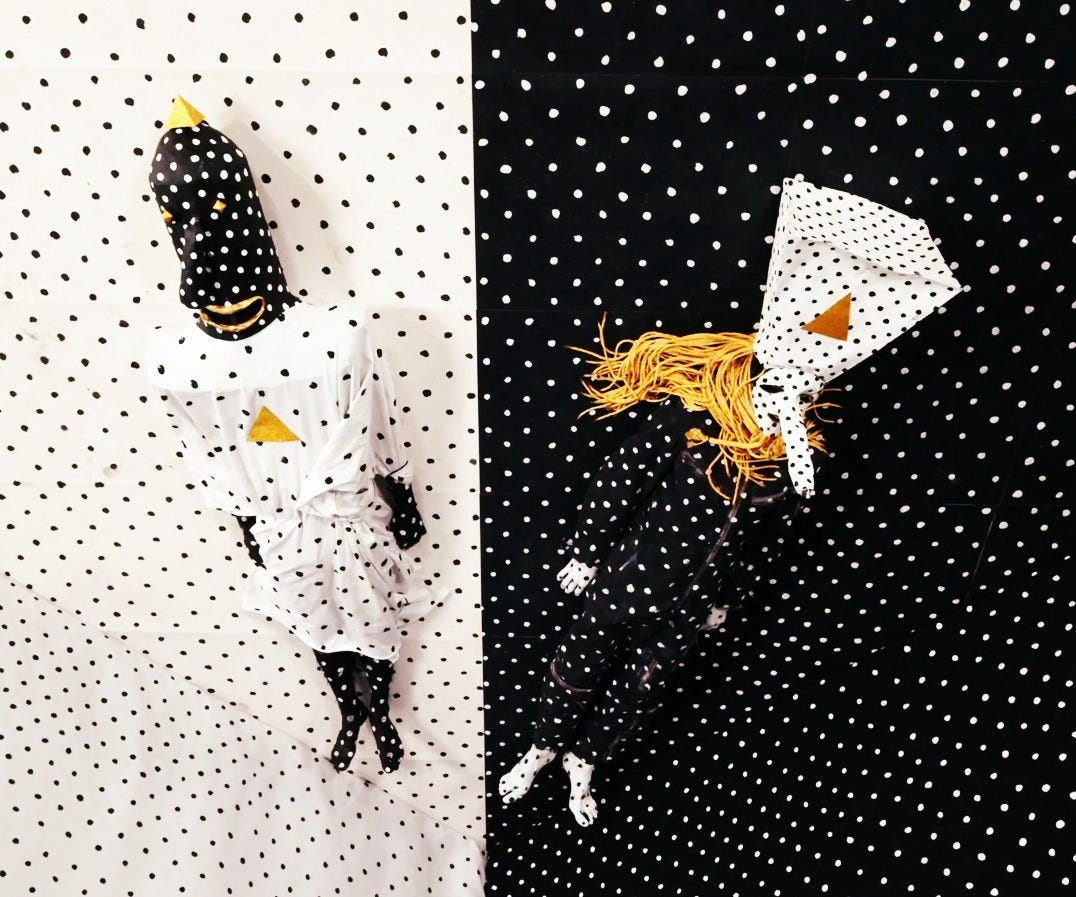
Yes, it is coincidence but I’m committing to the segue. And I don’t give a fuck if you disapprove of Angine De Poitrine, though if you love them you can come sit here next to me. I’m bringing them up because among other things, people are calling them an anti-AI band. Which is to say, they are so aggressively creative that AI could never create, or duplicate, their steez. Some of that is due to the complexity of the music they play: microtonal, math rock, blah blah. But the pedants are missing the point. Us normies love them because they’re talented, they’re surprising, and they’re fun
Here’s how Angine De Poitrine describe themselves:
Disciples of planet Earth’s rock deities, space-time voyagers Klek and Khn de Poitrine gaze in wonder at hot dogs, pyramids, and rock music in all its glorious excess.
Asymmetrical and dissonant, Angine de Poitrine’s music makes hearts race and bodies move with ecstatic abandon. Through tight, pulsing drum grooves and intricate tangles of double-neck microtonal guitar, the band summons swirling vortices of hypnotic sound and vision.
Not a word about how intelligent and clever and misunderstood they are! And yet, watching Khn de Poitrine play his ridiculous guitar/bass while building rhythm loops with his feet, turning knobs between his toes, it’s clear he did not skip rehearsals. This creativity—silly as it is—was not rushed. There is no hack for that level of foot dexterity (yet). It would appear that these guys have spent little time positioning themselves as smarter, or more talented, or anti-anything. They just came up with some funny costumes and a bit of lore, and played a lot of music. They seem to be having fun, listening to them is fun, and their look has inspired thousands of fan art posts in a matter of weeks. This isn’t a complex idea: to be anti-AI is to be human, and to be human is to be weird. Being weird is fun. But I think it’s easy to lose sight of this simple wisdom when we’re constantly in the swirl. The little sparkle in my brain when I listen to their music (or when I enter a writing contest) does not come from scrolling. It doesn’t come from anywhere other than human-centered endeavours. Even though I am exhausted. Even though I am an introvert. So I guess what I’m saying is that, if the best way to be anti-AI is to work hard, have fun, connect with other humans, and be aggressively creative (and burn down all the data centres) then that’s fine.
I thought about retooling my GritLit story and sending it elsewhere, but I’ll share it here instead. No edits since I submitted it, so very much imperfect. Thanks to Paige and everyone at GritLit for this opportunity.
Velveteen
After the call from the hospital Brenna sat on the bed and looked at her suitcase. Thoughts sorted themselves into two pathways. One led out the door, and was paved with practical concerns like ruining her makeup. The other, still slushy, circled round and round. The source of Mom’s recent strange behaviour was worse than anyone had guessed. Uprooting all the hostas from the garden and lining them up on the kitchen floor. Shouting at the pizza delivery guy. He was a good sport about it. A month ago the neighbours had found her wandering in the park, asking people what season it was. They walked her home and everyone had a laugh, including Mom. Said she was just wondering if it was time to replant the hostas.
Dementia. Brenna could see the word but she couldn’t absorb it. At some point she would have to. She’d think about brains—how they work, how they break, and where the broken ones go. She would come up with a comforting image of a brain afterlife, like The Velveteen Rabbit’s ascension to real bunny status after being tossed in the trash. A conclusion that was supposed to be happy, but, after her parents had closed the book and turned out the light, only made her squirm beneath the weight of the world’s unfairness.
Outside her motel room, Tara honked the horn. This made it easier to stand, zip, and leave. She had not done a final sweep of the room—what Mom always called a dumdum check—and worried for a second that her fancy retinol face wash might still be in the shower. Too late now, the keys were inside and she was late. A thousand kilometres away, Mom’s tongue tsk’d against the roof of her mouth.
“I think retinol works better in a cream,” Tara said later. They were pulling into the parking lot behind Nechako Valley school. “It’s a waste to rinse it off.”
“Wish someone had told me that before I dropped thirty bucks on it.” Brenna looked to see if Tara gave any sign that this was an extravagant price for face wash. She had only ever used Pears glycerin soap until last week, after looking in a motel mirror that magnified the skin around her eyes to a gruesome degree. How had she ignored all that drooping?
If Tara was repulsed by the expense she didn’t show it. “Meet you here in an hour. Everything okay?”
“Absolutely.” A necessary lie since not being okay wouldn’t change anything. Two grade eleven classes were waiting for her in the school library.
At the start of the tour Tara had watched all her presentations. She had a list of questions to ask if the Q&A was a little slow. And they usually were, since high school kids had other things on their minds. But the teachers still brought her in to speak, again and again, about why they should maybe also care about reading and writing stories.
Nechako Valley School was home of the Barons. A fat, cartoonish man with an axe, rendered in green and gold.
“What makes a Baron a good mascot?” she asked two dozen sleepy-eyed students.
“They owned land!” A freckled young man offered.
“They fought with honour,” said a young woman who looked oddly familiar.
“So could a Baron be a superhero?” She’d had a lot of luck with multiverse writing exercises—turns out those movies were good for something.
A steady murmur as they discussed this with reverent focus. What would a super-baron look like? What would his power be? The teachers, who had been circling the classroom like leopards, looked impressed.
Brenna had left her phone on the lectern under the pretence of staying on task. WhatsApp was blowing up with messages—did you hear about Mom? This was supposed to make her feel like she was keeping an eye on the situation but instead it was lifting the top off her head, threatening to spill out its contents. What would Tara think? This was important work they were doing, not to mention provincially-funded. Brenna made twice as much encouraging kids to write as she did writing. That money would pay for visits with Mom. She flipped over the phone with a hand that felt borrowed.
A voice rose from the back of the room. “That’s garbage.” The young woman from earlier jabbed an arm in the air.
At second look, Brenna realized this girl had the same haircut she had in high school. Winona Ryder’s iconic ‘bixie.’ “What’s garbage?” she asked.
The girl pointed at a student across the table. “He says a Baron can’t be a lady.”
Several students protested—for and against—but Brenna was still focussed on the girl. It wasn’t just the haircut, she looked nearly identical to young Brenna, almost as if she’d been plucked from that timeline and dropped into this one. She sat down at the table and looked at the student—at herself—expecting some kind of recognition. But age is a one-way mirror. The poor girl just looked uncomfortable.
“Usha Prashaar is a Baroness,” Brenna said, finally. “But not an old-timey one.”
A teacher rushed to put a photo of Prashaar on the overhead screen.
“Could she be a superhero?” Brenna asked.
“Too old,” a student said, and although that sounded right—not a lot of septuagenarian heroes in the Marvel universe—old Brenna deflated. Time swallowed everything. Her skin elasticity. Her mother’s brain. At the end of the presentation she thanked the students for their brilliance. Thanked the teachers for their vigilance.
On her way out the door, her doppelgänger stepped up. “I don’t think Usha’s too old for anything,” she said. “That’s garbage too.”
“Thanks,” Brenna said, accepting the compliment on Prashaar’s behalf.
“Here.” She handed Brenna a piece of foolscap, ripped into the shape of a rabbit. You are cool drawn into the centre.
As promised, Tara was waiting outside the school. Asleep in the driver’s seat. Must be nice, Brenna thought. She walked out past the GO Barons GO! sign at the school’s entrance. There was one cigarette in the pack at the bottom of her bag.
In the nineties, her high school had a dedicated smoking area in the parking lot. Teachers and students smoked together, which was absurd to think about now. Mom was the school librarian, so Brenna had to sneak cigarettes in the gully at the far end of the field before dousing herself with Tommy Girl perfume. When school got too loud she’d skip class and sit alone in the gully all afternoon, watching water striders cruise the creek.
Was it a sign when Mom started choosing gardening over conversation? Over most things? To Brenna it had just looked like a natural progression. She was thirty years younger and already preferred dirt to people. But no, it should be the opposite, shouldn’t it? More community as we age, and more stimulation? What a tiring thought.
She was composing a long, confident-sounding text for the family WhatsApp when Tara beeped the horn. A friendly beep. But Brenna stomped back and threw herself in the car, sighing deeply.
“I knew something was wrong.” Tara turned down the same Faith No More album she’d listened to every damn afternoon on the tour. “Heckled again?”
“You know what? I’m done. Take me to an airport.” This surprised them both, but it felt good. “You can’t be loving it. Glorified chauffeur? Nights at the Motel 6?”
Tara thought about this for longer than Brenna expected her to. She’d been hoping for a blow-out, something that would make it clear the tour was done and maybe—just maybe—their friendship was hanging in the balance.
“I would rather be writing,” she agreed. “You know what, a nice local at the gas station suggested a little detour.”
“I told you I’m finished—
“And I heard you but there are two of us in this car, and I want to go to DamFest.” Tara’s eyes were kind but her voice was not. Brenna realized she didn’t want a fight after all. She shrugged into her seat.
They said nothing until Tara turned off the highway. “It’s kind of a long detour.” She sounded apologetic. “You feel like talking yet?”
“Mom’s sick.” The words came out through cotton.
“Oh shit, is that why—we can turn around right now.” She looked in the rearview at the line of trucks behind them.
“Not that kind of sick.” Brenna felt exhausted by the idea of explaining. Get it out, Mom would say, in a tone that implied she had little time for whatever it was.
“Brain stuff?”
Brenna nodded.
“Okay.” She checked the rearview again. “My dad’s got it too.”
“Oh.”
“Not trying to one-up you or anything, just saying you’re not alone.” She laughed darkly. “Sure you don’t want to go back?”
“Where are we going, anyway?”
“This guy at the gas station told me they have a party at Kenney Dam every year. Food. Local bands. I guess I took it for granted you’d want to let off some steam.”
“When have I ever wanted to let off steam by mingling?” Brenna moaned, but DamFest did sound moderately appealing. More appealing than bed-rotting for another ten hours between schools. Maybe even better than facing her family. For now, anyway.
“Just let me know when you want to leave.” Tara patted her hand, and turned Faith No More back up.
Kenney Dam didn’t look like a dam at all, aside from all the water it was holding up. There was no grand concrete spillway like at the Hoover, or even the Peace Canyon Dam they’d passed outside Hudson’s Hope last week. To Brenna’s eye, it was just a pile of rocks.
“Bit underwhelming, don’t you think?” she asked a trio of locum nurses they met in the parking lot.
They shrugged off her scorn. “Looks better from the top of the lookout trail,” one told her. She pointed out the trailhead, marked by a boulder with NO BJs spray painted across it in Tremclad red.
The nurses also informed them that DamFest didn’t really get started until close to midnight. The trucks that had followed them in were early birds, claiming the best campsites before darkness fell.
“Shit, I’m sorry,” Tara threw up her hands and laughed. “I really thought I was saving the day here.”
“Let’s walk.” Brenna’s pique was evaporating. If anything she felt a little embarrassed. Of course she wasn’t the only one going through it.
They switchbacked up and up the No BJs trail, a nettle-lined path that must have been cut by a sadist. Twenty years ago she would have hauled up a case of beer in either hand. Now she huffed through smoker’s lungs. “I’m sorry about your dad.”
“I’m sorry for all of us.” Tara shook her head. “Oh hey, the motel called. I went back and picked up your face wash.”
“Oh, buddy.” Was this really going to be her undoing? Face wash? She blinked hard. Focussed on the pile of rocks holding back a whole canyon of river. Below them, the locals kept coming. In the campsites, tarps tied to pine limbs made a backcountry mosaic. Industrious young people carried lumber for the stage. A food truck powered up the generator and brought the smell of pulled pork. The nurses were right, things did look better from above.
Brilliant, engaging, relatable!
I tucked right into the energy of this post that rings so purely with this life and where and how we live it in our conscious and unconscious and self-conscious puny enormous selves. Thank you for this ❤️